
Learning to read darkness with the Bortle Scale
Darkness is not binary. A night can look dark while still missing most of the structure that makes a natural sky feel immense.
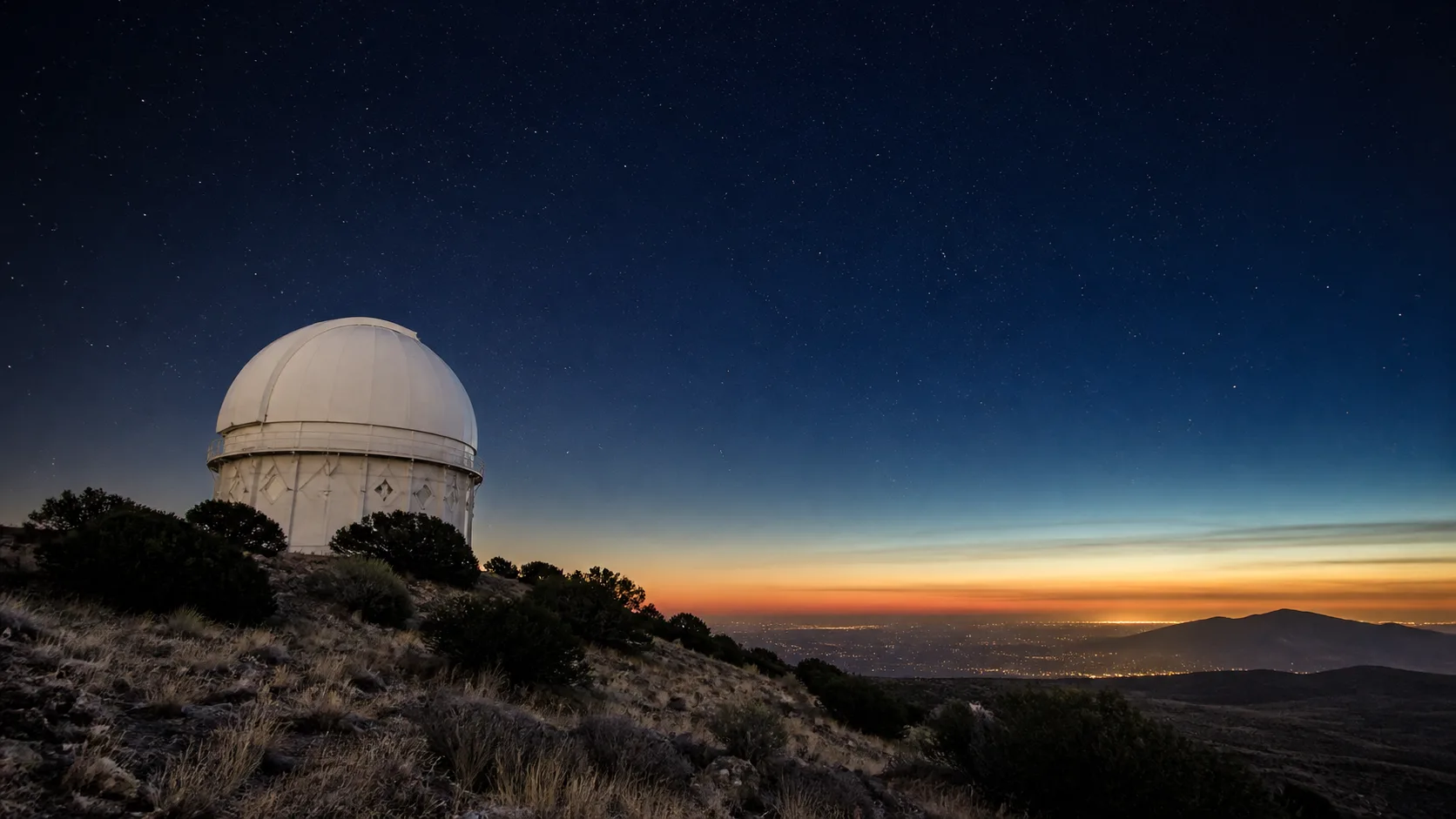
Nine classes, observed by a human eye
Amateur astronomer John E. Bortle introduced his nine-class scale in Sky & Telescope in 2001 so observers could compare sites using what they actually saw. Class 1 is an exceptionally dark natural sky: the Milky Way shows knots, lanes, and complex structure, zodiacal light can be conspicuous, and distant horizons carry little artificial glow. Class 9 is an inner-city sky in which the Moon, planets, and a small population of bright stars dominate.
The middle is where the scale becomes most revealing. Between a rural Class 3 and a suburban Class 6, the sky does not lose a uniform percentage of stars. Faint background stars vanish first. The Milky Way flattens from a structured band into a weak wash, then disappears. Clouds change character: dark silhouettes under a natural sky, they become luminous ceilings above a city.
A number is a prompt to look more carefully
The Bortle class is an observation, not a direct instrument reading. Transparency, humidity, altitude, nearby glare, the Moon, and an observer’s dark adaptation all affect the judgment. Two locations assigned the same class may feel quite different, especially near the horizon where light domes gather.
That subjectivity is not a defect. It reminds us that sky quality is an experience with several visible clues. A meter can report luminance precisely; the Bortle framework asks whether the Milky Way has structure, whether zodiacal light is apparent, and whether familiar constellations sit inside a rich field or float alone.
The deeper idea: baselines shift unnoticed
People judge darkness against the brightest place they know. A suburban sky can feel remarkable after downtown even though a natural sky contains thousands more visible stars. Each generation can inherit a slightly brighter night and accept it as normal. The scale gives that loss a vocabulary before memory smooths it away.
Use the number as a beginning. Record the date, weather, Moon, brightest visible features, light domes, and how long your eyes adapted. Return to the same place. A repeated description can become evidence of change—and a practical case for shielding fixtures, reducing output, and turning off light that serves no task.
Darkness is a quality, not an absence
Calling darkness “nothing” makes it sound expendable. A natural night is actually a set of conditions: low background brightness, gradual adaptation by the eye, visible contrast between stars and sky, and a horizon that has not been washed into a dome of scattered light. The Bortle Scale is useful because it turns those conditions into things an ordinary observer can recognize without pretending that one measurement tells the whole story.
That distinction changes the conservation question. The choice is not between total darkness and public life after sunset. It is between light designed for a particular human task and light allowed to spill upward, outward, and through the entire night. Shielding, warmer color, lower output, and sensible timing preserve visibility on the ground while returning contrast to the sky. A better Bortle class is therefore not a demand that a place switch itself off. It is evidence that a place has learned to light with care.
Back to The Night Sky →